The VR Modding Renaissance: How Fans Are Bringing Flat Games Into VR
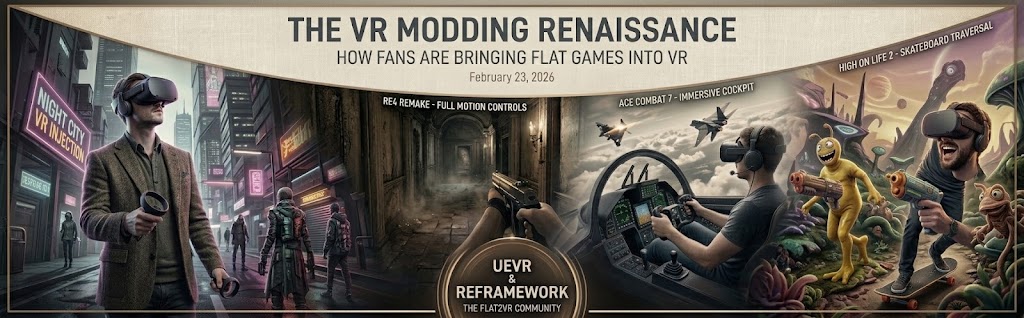
Something remarkable is happening in PC gaming right now. While native VR ports of big-budget games remain rare, a passionate community of modders is taking matters into their own hands. They are converting flat-screen games into full VR experiences, and the results are getting seriously impressive.
The Tool That Changed Everything: UEVR
Before we dive into specific mods, we need to talk about the most widely used tool in VR modding today: UEVR (Universal Unreal Engine VR Mod).
Created by a developer known as Praydog, UEVR is an open-source injector that adds full 6DOF VR support to almost any Unreal Engine 4 or 5 game. That means head tracking, stereoscopic 3D rendering, motion controller support, and even roomscale movement. It works with OpenVR and OpenXR runtimes, which means it supports basically every PCVR headset out there, from the Meta Quest 3 to the Valve Index to the Bigscreen Beyond.
The magic of UEVR is that it hooks directly into the Unreal Engine’s own stereo rendering pipeline. Instead of hacking together a fake 3D effect, it uses the engine’s native capabilities. The result is proper stereoscopic rendering with minimal performance overhead. Games look right. They feel right. And with the 1.05 release adding a full Lua scripting API, modders can now build custom plugins for individual games that add things like proper motion controls, weapon handling, and first-person camera adjustments.
UEVR has seen widespread adoption since its release on GitHub. The Flat2VR Discord community that surrounds it has become the central hub for VR modding, with thousands of active members sharing configurations, troubleshooting issues, and building plugins for specific games.
But UEVR is not the whole story. The VR modding scene runs deeper than one tool.
Cyberpunk 2077 in VR: A Story of Takedowns and Comebacks
No game captures the drama of VR modding better than Cyberpunk 2077. The journey to play Night City in VR has been a rollercoaster involving multiple modders, legal threats, and a community that refuses to give up.
The most well-known Cyberpunk 2077 VR mod came from Luke Ross, a modder who built a reputation creating “R.E.A.L.” VR mods for flat games. His mods used a technique that rendered the game world from two slightly offset camera positions to create a stereoscopic 3D effect. Over the years he built R.E.A.L. mods for GTA V, Red Dead Redemption 2, Cyberpunk 2077, and several other AAA titles.
Luke Ross ran his operation through Patreon, charging subscribers for access to his mods. This became a point of contention. CD Projekt Red (CDPR), the studio behind Cyberpunk 2077, eventually took action against the mod, forcing Luke Ross to take it down. The key issue? CDPR reportedly told Luke Ross that the mod could remain available if he made it free. He refused.
The community reaction was mixed. Some sympathized with Luke Ross, who had spent years building a complex mod. Others pointed out that charging money for mods that modify someone else’s copyrighted game is legally risky. The whole episode sparked a broader conversation about the ethics and legality of paid VR mods.
But Cyberpunk in VR did not die. Other modders stepped in with alternative injection tools and rendering techniques. The Reddit community regularly shares guides on the best current ways to experience Night City in virtual reality. The game remains one of the most requested VR mod targets, and for good reason. Walking through Night City in VR, looking up at the towering megabuildings and neon-soaked streets, is a genuinely different experience.

Resident Evil 4 Remake: Full Motion Controls in VR
Capcom’s RE Engine games have been a goldmine for VR modding, and Praydog himself built the foundation. His REFramework mod adds VR support to RE Engine titles including Resident Evil 2, 3, 7, Village, and the RE4 Remake. Players have praised how smooth the setup is and how impressive the graphics look in VR.
But the real excitement came when a modder named Talemann released a first-person motion controls mod for RE4 Remake. Built on top of Praydog’s REFramework using its Lua scripting capabilities, this mod transforms the game into something that feels close to a native VR title. You aim your weapons with your actual hands. You physically look around corners. The over-the-shoulder camera is gone, replaced by a proper first-person perspective.
The feedback has been mixed but passionate. Some players report amazing results, especially on high-end hardware. Players with high-end hardware like the RTX 5090 report outstanding results with DLSS enabled. Others have struggled with installation complexity and rendering quirks. That is the nature of VR modding today: the ceiling is incredibly high, but so is the floor.
The RE4 Remake in VR is particularly noteworthy because Armature Studio (published by Oculus Studios) previously released Resident Evil 4 VR as a Quest exclusive, rebuilt from the ground up. The modded PC version of the Remake offers something different: modern graphics, the latest gameplay changes, and PCVR fidelity that no standalone headset can match.

Ace Combat 7: The Surprise VR Hit
Ace Combat 7 was not on most people’s VR radar. Ace Combat 7: Skies Unknown originally shipped with a very limited PSVR mode on PlayStation. Only three missions were available in VR and only on PlayStation, leaving PC players wanting more.
Enter UEVR. Because Ace Combat 7 runs on Unreal Engine 4, modders were able to inject full VR support into the entire game. Not just three missions. All of them. Every dogfight, every canyon run, every missile lock. In VR. In the cockpit.
The results have been blowing up on Reddit, with posts reaching the top of r/virtualreality. Players pairing the mod with HOTAS (Hands On Throttle And Stick) setups are calling it one of the best VR flight experiences available. Some have gone even further with HOSAS (Hands On Stick And Stick) dual-stick configurations.
The post titled “Bloody hell, Ace Combat 7 in VR is so good now that you won’t believe it…” sums up the community mood perfectly. After years of begging Bandai Namco for a proper PCVR release, the modding community delivered exactly what fans wanted. It is one of the best examples of UEVR’s potential. A game that was never designed for full VR support now offers one of the standout cockpit experiences on PC.

High On Life 2: Skateboard Shooting in VR
Squanch Games’ High On Life 2 launched in 2026, and the UEVR community wasted no time. Within days of release, modders had the game running in full VR with 6DOF motion controls.
High On Life 2 is an Unreal Engine title, which means UEVR works out of the box. But dedicated modders went further, building custom profiles that add proper two-handed weapon aiming and first-person camera adjustments. The game’s signature talking guns and wild visual style translate surprisingly well to VR. Players report the skateboard traversal mechanic in particular is a blast in headset.
Performance is still a challenge. Multiple reports mention needing beefy hardware and running the latest nightly UEVR builds for best results. One player documented running the game on an RTX 4080 Super with a Quest 3 and shared detailed performance tips. This is the pattern with UEVR mods: someone gets a game working, shares their profile and settings, and the community iterates until the experience is polished.

CARNASIS: The SOMA VR Dream That Almost Was
Not every VR mod project makes it to the finish line. CARNASIS was an ambitious project to rebuild SOMA, Frictional Games’ acclaimed underwater horror game, as a full VR experience. It was being developed by the same developer behind the Amnesia VR remake, and a free demo was released that generated significant excitement.
Then came the bad news. In early 2026, the project was cancelled. The developer cited insufficient community support and the need for an official partnership with Frictional Games. The cancellation highlights one of the biggest challenges in VR modding: these are passion projects built by small teams or individual developers, often working for free in their spare time. Burnout is real. Legal concerns loom. And the technical challenges of converting a flat game to VR are enormous.
The community rallied. A post titled “Do you want SOMA VR? Then read this!” appeared shortly after the cancellation, exploring alternative paths to get SOMA working in VR. The desire for the experience is clearly there. Whether someone else picks up the torch remains to be seen.
The Key Players
Praydog
Arguably the most influential figure in VR modding right now. Praydog created both REFramework (for Capcom’s RE Engine) and UEVR (for Unreal Engine games). These two tools combined cover a massive portion of the modern gaming landscape. He describes himself as a software developer who has been “pulling games apart for fun for 13+ years.” Everything he releases is free and open source. He accepts donations through Patreon but never locks his tools behind a paywall.
Praydog’s approach stands in contrast to modders who charge for access. His tools are infrastructure. They enable an entire ecosystem of game-specific mods and plugins built by other developers. The Lua API in UEVR 1.05 was specifically designed to make it easier for other modders to build on top of his work.
Luke Ross
A controversial figure. Luke Ross built some of the earliest high-profile VR mods for AAA games through his R.E.A.L. mod series. His work brought VR to GTA V, Red Dead Redemption 2, Cyberpunk 2077, Elden Ring, and many other titles. The technical achievement was real, but his insistence on paid-only access through Patreon eventually led to conflicts with game publishers. The CDPR takedown of his Cyberpunk mod drew the most attention, with the community debating whether his response was principled or stubborn.
Talemann
A newer name in the scene, Talemann’s first-person motion controls mod for the RE4 Remake showed what is possible when you combine Praydog’s framework with creative game-specific modifications. The mod is ambitious, and while not everyone has had a smooth experience with it, it represents the cutting edge of what VR modding can achieve.
The Flat2VR Community
The backbone of the whole scene. The Flat2VR Discord is where the VR modding community lives. It is where configurations are shared, bugs are reported, and new modders learn the ropes. Without this community, UEVR profiles for individual games would take much longer to develop and polish. The collective knowledge and troubleshooting here is what turns a “technical demo” injector into a polished VR gaming experience.
What Makes This a Renaissance?
A few things are converging right now.
The tools have matured. UEVR is not a proof of concept anymore. It is stable, well-documented software with a plugin system and scripting API. REFramework is similarly polished. These are real tools that real people use daily.
The community has critical mass. The Flat2VR Discord, various Reddit communities, and YouTube channels dedicated to VR modding have grown to the point where getting a new UEVR game working is a community event. Someone injects the game, shares initial impressions, and within days there are optimized profiles and custom plugins.
Hardware is catching up. Modern GPUs like the RTX 4080 and 5090 series can actually run demanding games in stereoscopic VR at acceptable framerates. DLSS and FSR help enormously. The hardware bottleneck that made VR modding impractical for many games a few years ago is finally easing.
Studios are leaving the door open. While CDPR took action against a paid mod, many publishers have taken a hands-off approach to free VR mods. Praydog’s tools have been available for years without legal challenge. This tacit acceptance matters.
The Challenges Ahead
It is not all smooth sailing. VR modding still has real problems.
Performance. Even with DLSS and modern GPUs, running a demanding game in stereoscopic VR at 90Hz is brutal on hardware. Many UEVR games require significant settings reduction or accept lower framerates.
Comfort. Games designed for flat screens often have camera movements, cutscenes, and effects that cause motion sickness in VR. Modders can mitigate some of this, but not all of it. A game designed for VR from the ground up will almost always be more comfortable than a converted flat game.
Stability. UEVR is impressive, but it is still injecting code into games that were never designed for it. Crashes happen. Visual glitches happen. Each game update can break compatibility. This is not plug-and-play gaming.
Legal uncertainty. The Luke Ross situation showed that publishers can and will act against mods they find objectionable. The line between acceptable and unacceptable remains unclear, and it seems to depend heavily on whether money is involved.
Where Do We Go From Here?
The trajectory is clear. VR modding is growing, the tools are improving, and the community is more organized than ever. UEVR alone covers thousands of Unreal Engine games. REFramework handles the RE Engine catalog. And individual modders continue to push the boundaries with game-specific enhancements.
If you have a PCVR headset and have not explored VR modding yet, now is the time. The UEVR website is the best starting point. The Flat2VR Discord is where you will find community-made profiles and support. And Reddit communities like r/virtualreality regularly feature new VR mod discoveries.
Whether or not studios ship official VR modes, fans are proving it can be done. And honestly? They are getting pretty good at it.