Keep Talking and Nobody Explodes on Quest: A Family Guide
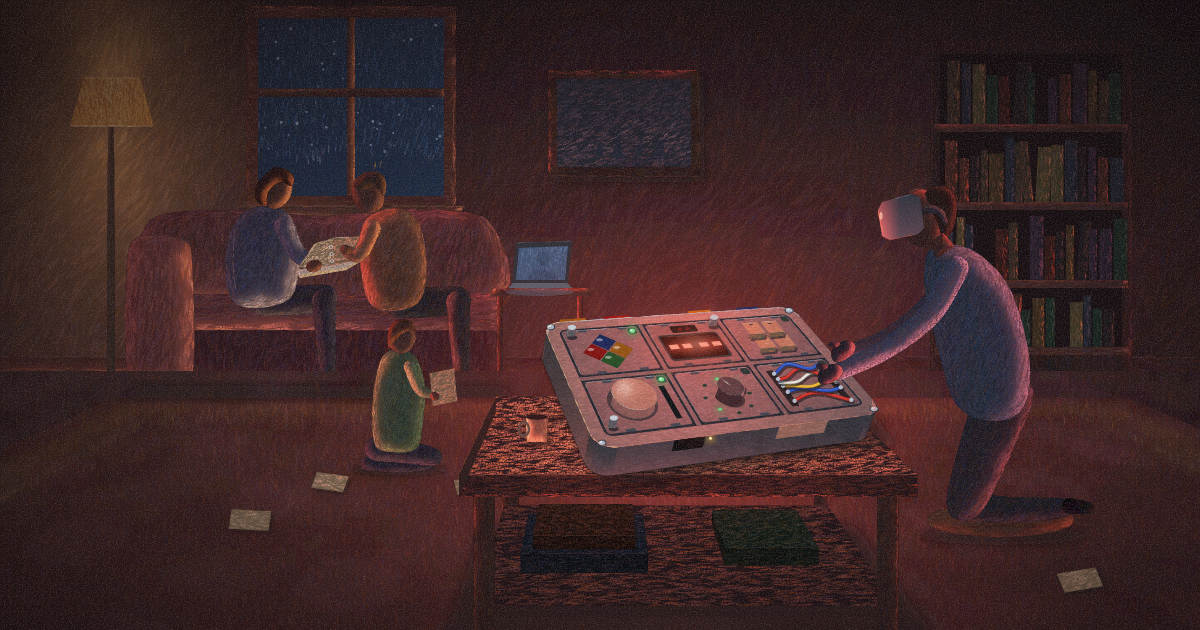
Keep Talking and Nobody Explodes is one of the few VR games built around the people who are not wearing the headset. One player holds a ticking bomb in virtual reality. Everyone else holds the instructions on paper or a phone and cannot see the bomb. The only way through is to describe, listen and answer quickly. This guide is for parents planning a holiday game night: what you need, how to get the free manual, where a young or new team should start, and how a grandparent three states away can play too.
How Keep Talking and Nobody Explodes works
The Meta store listing sums it up: you are alone in a room with a bomb, your friends have the manual, and “they can’t see the bomb,” so the group has to talk it out. The Meta Horizon Store page says it needs two or more players and that “only one VR headset with the game is needed.”
Steel Crate Games, the developer, splits the roles this way in its Quest how-to-play page:
- The Defuser wears the Quest and sees the bomb, but never the manual.
- The Experts read the Bomb Defusal Manual and guide the Defuser. “Any number of players can participate as Experts.”
The manual explains the stakes: a bomb explodes when its timer reaches 0:00 or when too many strikes are recorded. A bomb with a strike indicator explodes on the third mistake, and the timer runs faster after each strike. A bomb can hold up to 11 modules, and the team can solve them in any order.
What it costs and how low it has gone on sale
On November 23, 2026, the game costs $14.99 on the Meta Horizon Store, according to its VRDB page. The same page puts the lowest tracked price at $2.99 on June 26, 2026, so a parent who can wait may find it much cheaper in a later sale. The VRDB on-sale page lists current Quest discounts.
A few other details from that VRDB page that matter to families:
- It runs on Meta Quest 2, Quest 3, Quest 3S and Quest Pro.
- It is rated Everyone 10+ for mild violence and has no in-app ads.
- Its comfort level is Comfortable, and it supports sitting, standing and room-scale play.
- VRDB lists it as Cross-Buy, and the developer’s FAQ says that covers Rift and Quest.
- It needs no internet connection and takes 208 MB of space.
Only the Defuser needs the game. Steel Crate Games’ remote play page says the Experts “do not need the game installed to play,” so one purchase covers a whole living room.
Getting and printing the free Bomb Defusal Manual
The manual is free at bombmanual.com, where you can view or print it as a PDF, read it as a web page, or pick another language. The printed version is 23 pages. It covers each module in Section 1, the “needy” modules in Section 2, and reference pages at the back for the indicators, batteries and ports printed on the bomb’s casing.
Print it before the party. The first time the game starts, it asks for a verification code, which is on the manual’s title page, as the Quest how-to-play page explains. The code confirms you are using the right version of the manual. If a later version of the game needs a new manual, it asks for the new code, and that is your cue to print again.
Some ways families use the printout:
- Print two copies, or staple each module’s page separately, so several Experts can search at once.
- Keep the appendix pages loose. Several modules send you there to check the serial number or battery count.
- Give younger Experts a phone or tablet with the web version so they can zoom in on the symbol tables.
Which modules to learn first
Every new team starts the same way. The game’s FAQ says you “must complete ‘The First Bomb’ mission to access ‘Free Play’ mode,” so the opening missions set the pace.
The manual puts its three simplest modules first, and they are the ones to read together before anyone puts on the headset:
Wires
A wire module has three to six wires, and only one is the right one to cut. The Expert asks how many wires there are and what colors, then reads down a short list of rules. Some rules depend on whether the last digit of the serial number is odd, so the Defuser should read the serial number aloud at the start of every bomb.
The Button
The Expert checks the button’s color and label, and the number of batteries, then tells the Defuser either to tap it or hold it. When held, a colored strip lights up, and its color decides which digit on the timer means “let go.” It is a good module for teaching a child to say exactly what they see.
Keypads
Four buttons show unusual symbols. The Expert finds the one column in the manual that holds all four and reads off the order to press them. Since the symbols have no names, this one rewards creative description (“the one that looks like a backwards C with a dot”).
What to save for later
The manual lists harder modules after those three: Simon Says, Who’s on First, Memory, Morse Code, Complicated Wires, Wire Sequences, Mazes and Passwords. Section 2 adds Venting Gas, Capacitor Discharge and Knobs. These needy modules can never be disarmed and come back on their own timer, so they work best once the team is comfortable.
Once Free Play opens, the FAQ says you can switch off up to three modules under Options, then Accessibility. That lets you build a practice bomb without the module your youngest Expert finds hardest. The FAQ notes that this setting changes Free Play only, not the missions.
Tips for a young or first-time team
- Pick a calm reader. The best first Expert is often the person who reads aloud clearly, not the fastest one.
- Take turns in the headset. Missions are short. The remote play page says rounds last “5 minutes or less,” so everyone can try the Defuser seat in one evening.
- Agree on words. Decide in advance whether you count wires from the top and what you call each color.
- Play seated. VRDB lists sitting mode, so a child can play from a chair or couch with the room cleared around them.
Playing in mixed reality on Quest 3
When the game came to Quest 3, Steel Crate Games’ October 10, 2023 press release said mixed reality lets players “see their Experts in the same room as them while they select their missions.” The release describes that view at mission select, and the core rule stays the same: the Defuser never sees the manual. VRDB lists mixed reality support for the Quest version, and the Meta Quest 3 page on VRDB lists other games for the headset.
Playing with family over a video call
You do not need everyone in one house. The Quest how-to-play page says you can “play remotely using your favorite voice chat service,” and Steel Crate Games’ remote play page names Discord and Zoom as examples. A family video call works like this:
- The Defuser plays on the Quest in your home, with the call audio on a speaker or laptop in the room.
- Remote Experts open the manual at bombmanual.com on their own screen or print it themselves.
- Everyone talks. Experts at home and on the call can split modules between them.
One limit to know before the party: the remote play page says that each person who wants a turn as Defuser needs their own copy of the game. A cousin on a call can be an Expert for free, but cannot take the bomb from their own house without buying it.
Is it worth it for a holiday game night?
If your family enjoys talking over each other, it is hard to find a VR game that brings non-players in so directly. It costs $14.99, or less in a sale, the manual is free, and the Experts need no headset. VRDB shows a 4.5-star rating from 571 ratings on the Meta store. Print the manual, read the first three modules together, and hand the headset to whoever reads the serial number out loud the clearest.
